P4 — Autonomous Loading Robot
Autonomous Loading Robot in Warehouse Simulation
This project presents the development of an autonomous robot system capable of navigating a warehouse environment, transporting shelves, and placing them in designated locations. The main goal is to combine path planning, precise motion control, and state-based task execution to achieve fully autonomous loading operations.
The system is designed to handle shelves of different sizes, avoid collisions, and interact with a simulated warehouse map to update the occupancy grid in real time.
General Strategy
The architecture integrates several modules:
- Occupancy Map Handling: Processing warehouse maps, inflating obstacles, and adapting images for path planning.
- Path Planning: Generating collision-free trajectories using the OMPL Reeds-Shepp planner, supporting forward and backward motion and minimum turning radius constraints.
- Control and Navigation: Ackermann-style velocity and steering control to follow planned paths with precision.
- Shelf Manipulation: Lifting and depositing shelves using virtual actuators, updating the occupancy map accordingly.
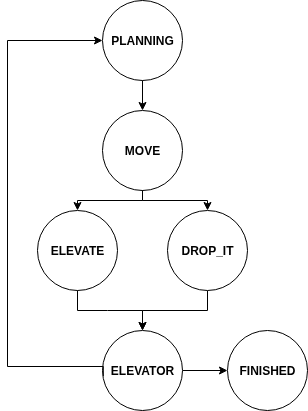
- State Management: A finite state machine (FSM) coordinates planning, moving, elevating, dropping, and waiting stages.
Occupancy Map Processing
The robot relies on a map image of the warehouse. Several transformations are applied:
- Map Inflation: Obstacles are expanded by the robot radius to ensure safe navigation, if it’s necessary.
- Numpy Adaptation: The map is converted to numerical arrays for easy computation, where free space and obstacles are encoded with distinct intensity values.
- Coordinate Transformations: Functions convert between world coordinates and map pixels, enabling accurate collision checks and path visualization.
Path Planning with OMPL
Collision-free paths are planned using Reeds-Shepp curves:
- State Validity: Each state is checked for collision by evaluating the robot’s footprint or the shelf’s footprint if carrying a load.
- Planner Setup: The robot space is bounded to the warehouse dimensions. Start and goal positions include x, y, and yaw coordinates.
- Planner Execution:
RRT*searches for an optimal path, interpolated for smooth execution. - Path Visualization: Planned paths are drawn on the map using lines and points, providing real-time feedback of trajectories.
Control and Motion
While moving along the path:
- The robot computes the distance and angular error to the next waypoint.
- Linear and angular velocities are adjusted using proportional control to reduce positional and heading errors.
- Special alignment maneuvers are executed when approaching shelves to ensure precise pickup.
- Motion parameters are adapted depending on whether the robot is carrying a shelf or not.
Shelf Manipulation
The robot performs two main operations with shelves:
-
Elevate (Pickup):
When the robot reaches a shelf position, it lifts the shelf usingHAL.lift(), temporarily removes it from the occupancy map, and marks it as carried. -
Drop (Deposit):
Upon reaching the target position, the shelf is placed usingHAL.putdown(), and the occupancy map is updated to reflect the shelf’s new location.
A waiting time ensures the elevator mechanism completes its movement before resuming planning.
Finite State Machine
The robot’s behavior is coordinated by the following states:
-
PLANNING
Computes a new path to the current goal using the updated occupancy map. -
MOVE
Follows the planned trajectory while correcting speed and heading, including special alignment for pickup points. -
ELEVATE
Lifts the shelf from the floor and updates the map. -
DROP_IT
Deposits the shelf at the target location, updating the occupancy map. -
ELAVATOR
Waits for the lifting or dropping operation to finish before proceeding. -
FINISHED
Indicates completion of all assigned transport tasks.
The FSM ensures robust sequencing of actions and allows the robot to autonomously cycle between multiple pickup and drop locations.
Visualization and Supervision
The WebGUI interface shows:
- The current occupancy map with obstacles and shelves.
- Planned paths with waypoints and traveled trajectories.
- Updates in real time as shelves are moved, providing intuitive supervision of the robot’s operations.
Videos
Holonomic Robot
Ackermann Robot
Conclusions
The autonomous loading robot demonstrates effective integration of path planning, motion control, and task sequencing in a warehouse scenario.
Key achievements include:
- Collision-free navigation in dynamic warehouse maps.
- Autonomous pickup and deposition of shelves with precise positioning.
- Real-time visualization of paths and occupancy updates.
- Modular FSM design, making it easy to extend or modify tasks.
This system forms a foundation for future autonomous logistics solutions, capable of handling multiple transport goals with minimal supervision.